
Searchers ask about "Game of Thrones season 9" or a 2026 season
There is no Game of Thrones season 9, and nothing has been announced for a 2026 continuation of the original series. The confusion is understandable: the show that most people mean when they search "Game of Thrones" concluded with its eighth season, but HBO has continued making television in the same fictional world, which keeps the title circulating in the news as though the flagship series were still airing.
The parent series, which premiered in 2011, ran for eight seasons before ending, a complete and closed story with no additional season in production or development. What is still active is the prequel side of the franchise, beginning with House of the Dragon, which is a separate, distinct show set centuries earlier in the same world and following the Targaryen dynasty rather than the Stark-Lannister-Baratheon conflict of the original run. If a search result or headline mentions "Game of Thrones" and a future year, it is almost certainly describing one of these spin-offs, not a season 9 of the original.
For a newcomer, the practical takeaway is simple: the original series is finished and complete at eight seasons, and anything billed as new is happening under a different title within the same universe.
A reader wants to watch the series and cannot find it
Whether you can stream Game of Thrones for free depends entirely on your subscription and your country, because the show is not carried the same way everywhere. In the United States, the series streams as part of a subscription through HBO Max, which holds the show as part of its library rather than offering it as a standalone rental.
Outside of a subscription, individual seasons and episodes can be bought or rented on a per-episode basis. Two of the widest available purchase options are:
- Prime Video — Season 1 is listed for purchase or rental episode-by-episode or as a full season, a route that works even without an HBO subscription.
- Google Play — the series is also available to buy on Google Play's TV store, which functions the same way: pay per episode or per season rather than a recurring subscription.
If your household already pays for HBO Max, that is the simplest path since every season is included. If not, buying through Prime Video or Google Play avoids a new subscription but costs more per season than a month of streaming would. Either way, the fastest way to settle "is it on Netflix" for your own account is to check your own region's Netflix catalog directly, since licensing agreements vary by country and change over time — the show is not on a single global Netflix library, and its absence from Netflix in most markets is why HBO's own platform and the purchase options above are the reliable ways to watch it.
George R. R. Martin writes A Song of Ice and Fire, beginning with A Game of Thrones (1996)
The television series adapts a book series, not the other way around. George R. R. Martin's ongoing novel sequence, A Song of Ice and Fire, began with A Game of Thrones, published in 1996, which supplied the title, the setting, and the early plot for everything that followed on screen.
HBO's television adaptation shares that title for its first season and follows the novels closely in its earliest years. But Martin's book series was not finished by the time the show needed new material, so the later seasons moved past the published books and continued the story using plot direction developed for television rather than text Martin had already written. That divergence is the reason the show's later seasons and the novels (where published) tell overlapping but not identical stories, and it is why readers who want the "original" version of later events have to wait on Martin's still-unfinished books rather than reread a chapter that already exists.
For a newcomer deciding where to start, the choice is really about pacing and authorship: the novels give Martin's own prose and, for the earlier seasons, the same events in more detail; the show gives a finished ending but one that departs from Martin's plans in its final stretch.
Rival houses press competing claims to the Iron Throne of the Seven Kingdoms
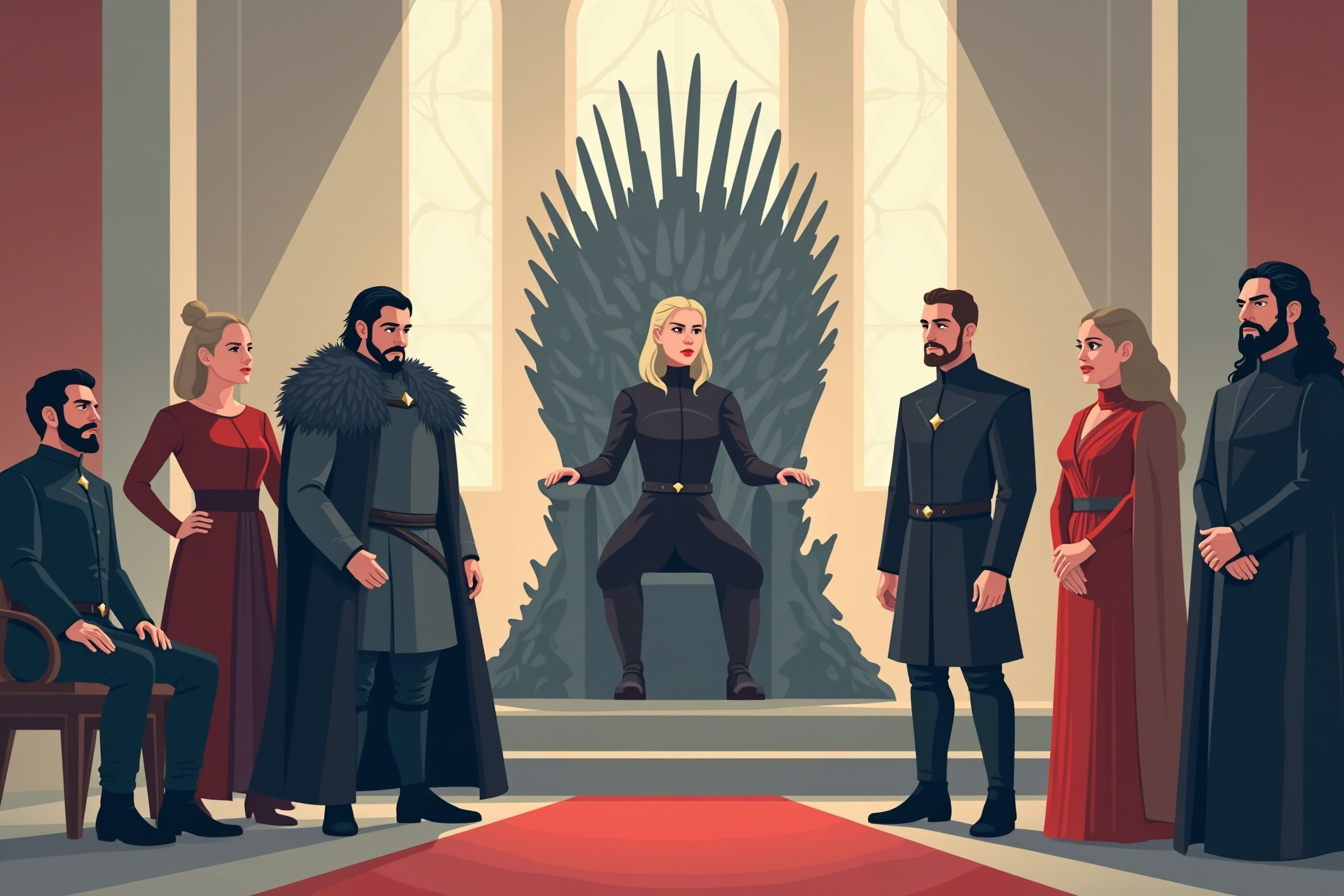
The premise is a succession crisis. Several noble houses — chiefly Stark, Lannister, and Targaryen — each press a claim to rule the Seven Kingdoms of Westeros from the Iron Throne, and the eight-season story follows how those claims collide through war, marriage alliances, betrayal, and the reappearance of dragons tied to the exiled Targaryen line.
That conflict structure is what carries the show across its run, with alliances shifting from season to season as houses that were enemies become allies and vice versa, and the Lannister family in particular recurring as the house most often at the center of court intrigue in King's Landing. Critical reception across that run has been tracked in aggregate critic and audience scores, which show a show that was overwhelmingly well-reviewed for most of its run, with reception becoming more divided in its final stretch — useful context for a newcomer deciding how much to expect from the ending versus the earlier seasons.
Game of Thrones (TV series)
The HBO drama is the anchor of the whole franchise: an eight-season adaptation that turned Martin's novels into one of the most widely discussed shows of its era, and it remains the entry point most people mean when they search the title, distinct from the prequels and games that share its name.
A Game of Thrones (novel)
The 1996 novel of the same name is where the title originates, and it remains the first book in Martin's still-ongoing Song of Ice and Fire sequence, documented in detail on its own page separately from the TV series it inspired.
Seven Kingdoms / Westeros
Westeros, divided into the Seven Kingdoms, is the fictional continent whose unified rule is the story's central prize. Nearly every major plotline in the series — a war, a wedding, an invasion, a wall in the north — exists because some house or claimant wants to control it.
Noble houses (Lannister, Stark, Targaryen)
These three houses are the story's principal dynasties, each with a distinct claim and character: Stark loyalty and honor, Lannister wealth and political scheming, and Targaryen exile and dragons. Their competing fortunes are the throughline a newcomer should track across the run, since most other houses' stories orbit around alliance or conflict with one of these three.
Dragons
Dragons are the signature fantasy element of the setting, historically the weapon that let the Targaryen dynasty conquer and hold Westeros in the first place. Their reappearance during the show's timeline is treated as a turning point precisely because they had been considered extinct, and the same imagery carries over into the prequel era explored in later spin-off titles.
Is there a new season of Game of Thrones coming out in 2026?
No season of the original Game of Thrones is scheduled for 2026 or any other year; the series concluded at eight seasons with no announced continuation. Any future Westeros television will most likely arrive under a spin-off title such as House of the Dragon rather than as a new season of the original show, so the surest way to track new Westeros content going forward is to follow announcements tied to those specific titles rather than searching for a season number that does not exist.
If you're ready to watch or rewatch the original eight seasons, start by checking whether your existing streaming subscription includes HBO Max, then fall back to per-episode purchase through Prime Video or Google Play if it doesn't.
Leave a Reply