
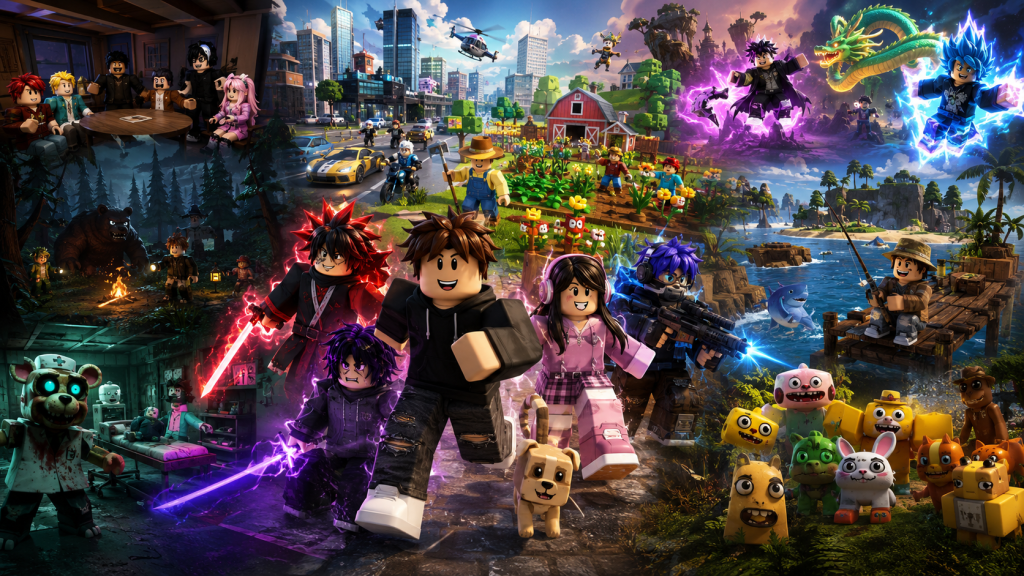
Roblox has long since stopped being “just a game platform.” In 2026, some of its biggest experiences regularly pull in hundreds of thousands of players at once, putting their audiences on a level that plenty of major PC games would be happy to reach.
So, if you’re opening Roblox and have no idea where to start, there are some obvious places to look.
For this list, I’m using two numbers as the main reference points: the current player count in August 2026 and each game’s Approval Rating on the official Roblox website. That gives us a useful mix of raw popularity and how positively players rate each experience.
| Rank | Roblox Game | Players Online | Approval Rating | Best For |
|---|---|---|---|---|
| 1 | Murder Mystery 2 | 603.8K | 90% | Social deduction |
| 2 | Brookhaven RP | 575.2K | 85% | Open-world roleplay |
| 3 | Grow a Garden 2 | 482.4K | 88% | Farming and progression |
| 4 | Blox Fruits | 381.9K | 92% | Anime RPG gameplay |
| 5 | 99 Nights in the Forest | 298.9K | 93% | Co-op survival |
| 6 | RIVALS | 247.4K | 93% | Competitive FPS combat |
| 7 | Animal Hospital (Anomaly) | 243.2K | 94% | Multiplayer horror |
| 8 | Jujutsu Shenanigans | 155.9K | 86% | Battleground fighting |
| 9 | Fish It! | 121.6K | 82% | Relaxing fishing gameplay |
| 10 | Steal a Brainrot | 117.6K | 85% | Casual collecting and chaos |
The biggest Roblox games are sitting around the half-million concurrent-player mark. That’s a ridiculous audience, especially when you compare it with some of the biggest games on Steam.
Other outlets have their own rankings as well, but these numbers give us a solid starting point.
The bigger question is what each game actually feels like when you play it. Here’s how the current Roblox heavy hitters stack up from the perspective of someone jumping in for the first time.
1. Murder Mystery 2
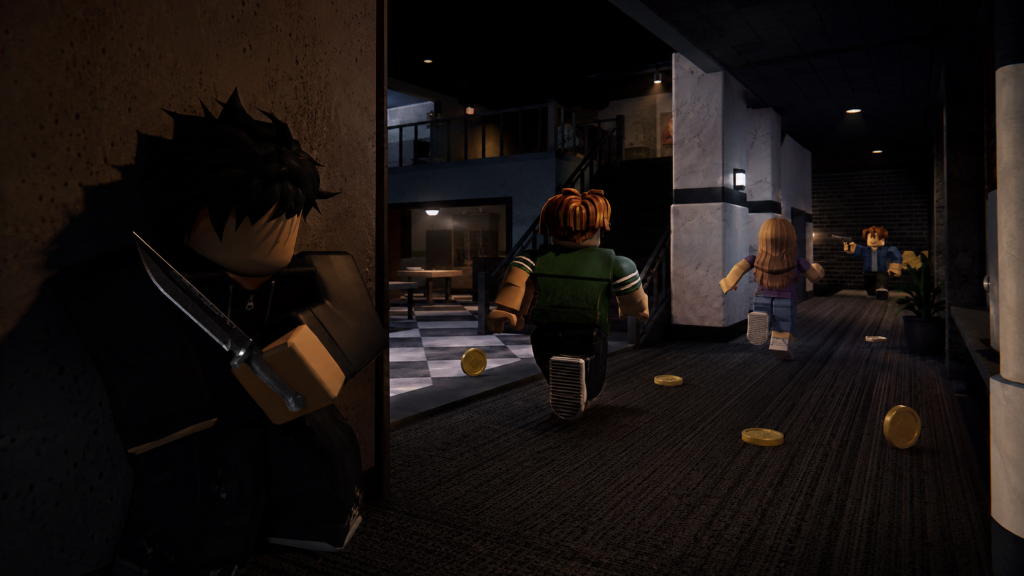
Murder Mystery 2 takes the basic idea of games like Among Us and turns it into a fast social-deduction experience.
Each round assigns players one of three roles: Innocent, Sheriff, or Murderer. Innocents need to figure out who the killer is or simply stay alive. The Sheriff has a gun and is the only player equipped to take the Murderer down.
The basic loop is extremely easy to understand. Once the round begins, Innocents run around collecting coins while trying not to get caught by the player throwing knives at them. Get killed and you lose your coins. Become the Murderer and the situation is reversed: you’re hunting everyone else.
If the Sheriff manages to eliminate the Murderer, the round ends. Dead Innocents simply return to the lobby and wait for the next map.
And the lobby isn’t just a waiting room. You can check the leaderboard, buy knives that are on sale, and chat with everyone between rounds. There are also hundreds of knife designs to collect and trade.
That’s a big part of the game’s staying power.
PCGamesN has described Murder Mystery 2 as an addictive arena experience, with its short rounds making it very easy to fall into the “just one more game” trap. Players generally praise the maps, straightforward roles, and replayability. The complaints are familiar, though: hitboxes can feel inconsistent, and veteran players would like to see more maps and modes.
For newcomers, it’s still one of the easiest Roblox games to understand. For longtime players, collecting and trading knives becomes a major reason to keep coming back.
2. Brookhaven RP

If Murder Mystery 2 wants you to kill someone, Brookhaven RP basically asks you to decide what you want to do with your afternoon.
It’s an open-ended social sandbox with very few traditional objectives. You choose a house, grab a vehicle, explore the city, and create your own stories with the other players around you.
The city has stores, houses, a simple subway system, and plenty of places to wander around. Your avatar also gets a surprisingly large collection of tools and options, including:
- Phone
- Tablet
- Props
- Signs
- Houses
- Food
- Laptop
- Animations
- Transport
The animation menu lets you change how your character moves or express emotions. Some animations are free, while others require VIP access.
Then there’s transportation. You can use everything from scooters and skateboards to horses, boats, and supercars.
Housing works in a similar way. The property menu shows available plots and the houses that can be placed on them. Some options are locked behind VIP, but there are free choices too. One of the standard houses is a modern villa with a garage, terrace, bedroom, and upstairs office.
It actually reminded me of the old PS3 Home experience.
Brookhaven also has props that include weapons, although you can’t use them to shoot or kill other players. Pets are available too, giving you yet another thing to mess around with.
The main appeal is freedom. There’s a lot available immediately, but you’re mostly left to figure out how everything works yourself.
That accessibility is also what makes Brookhaven so popular. Media coverage often points to how easy it is to pick up, while Common Sense Media has criticized the experience for providing plenty of wandering without much mechanical depth.
Players are split on the same issue. Some think the game feels empty or dated. Others argue that its huge population, straightforward design, and low hardware requirements make spontaneous roleplay much easier than in smaller social games.
3. Grow a Garden 2
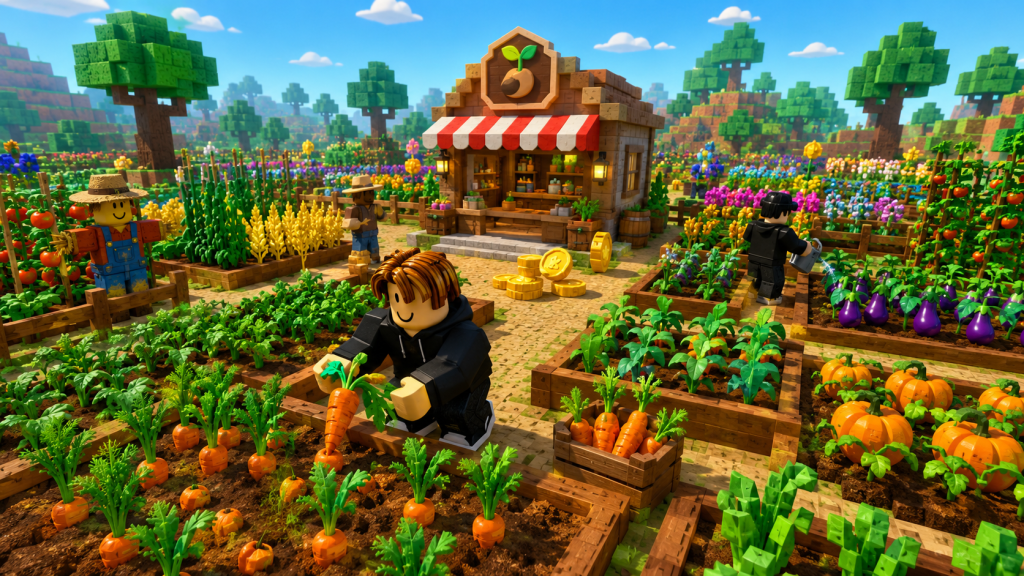
Grow a Garden 2 keeps the basic formula that made the original so popular: buy seeds, plant them, wait for crops to grow, and sell what you harvest.
Your garden continues developing even while you’re offline, but the sequel adds more direct competition through guild events and nighttime stealing.
Thankfully, the game doesn’t throw all of this at you at once. When you start, you’re given instructions that walk through the basic loop.
It goes something like this:
- Get your own garden plot.
- Visit the Seed Shop in the middle of the map.
- Buy a Carrot seed for 1 coin.
- Plant it.
- Wait for it to grow.
- Harvest the Carrot.
- Sell it at the shop for 4 coins.
- Repeat.
That’s Grow a Garden 2 at its simplest.
Naturally, the systems become more complicated as you progress. Your garden sits alongside those belonging to other players, while guild competitions add another layer to progression. Weekly rewards can depend on guild harvests, giving players a reason to work together rather than simply maintain their own plot.
Games.gg has argued that these additions give the sequel more going on than a passive farming simulator.
Reception has been mixed, though. Some players think the added mechanics work but take away from the calm atmosphere that made the original appealing. Others are much more critical, arguing that Grow a Garden 2 doesn’t do enough to separate itself from the first game despite its enormous launch popularity.
4. Blox Fruits
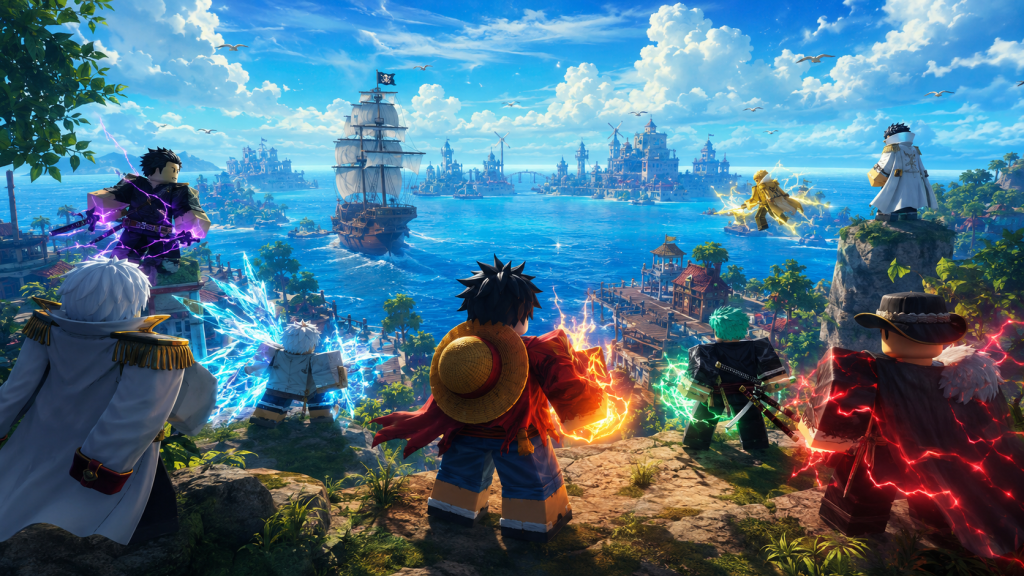
Blox Fruits is probably the closest thing on this list to a traditional MMORPG.
It’s an anime-inspired action RPG built around quests, exploration, bosses, swords, supernatural fruit abilities, character stats, and a long progression path packed with weapons and builds.
The One Piece influence isn’t exactly subtle, either.
You travel between island-based locations across an ocean, with boats providing your main way of getting around. Even the smallest boat can be purchased for free.
The game also has two factions to choose from: Marines and Pirates.
Combat and progression should feel familiar if you’ve played a classic MMORPG. You earn levels by completing quests and defeating enemies, then spend the points you receive on character stats. Abilities have cooldowns, adding another familiar MMO-style layer to combat.
There’s a surprising amount of atmosphere here for a Roblox game.
Polygon has previously pointed to Blox Fruits as an example of how unofficial anime-inspired Roblox experiences can attract huge audiences, sometimes outperforming officially licensed alternatives.
Players tend to like how clearly the progression works. You’re almost always working toward another level, weapon, ability, or upgrade.
The downside is the grind.
Moving forward often means killing similar groups of enemies over and over again, so Blox Fruits is much better suited to players who enjoy long-term character progression than anyone looking for a tightly paced adventure.
5. 99 Nights in the Forest
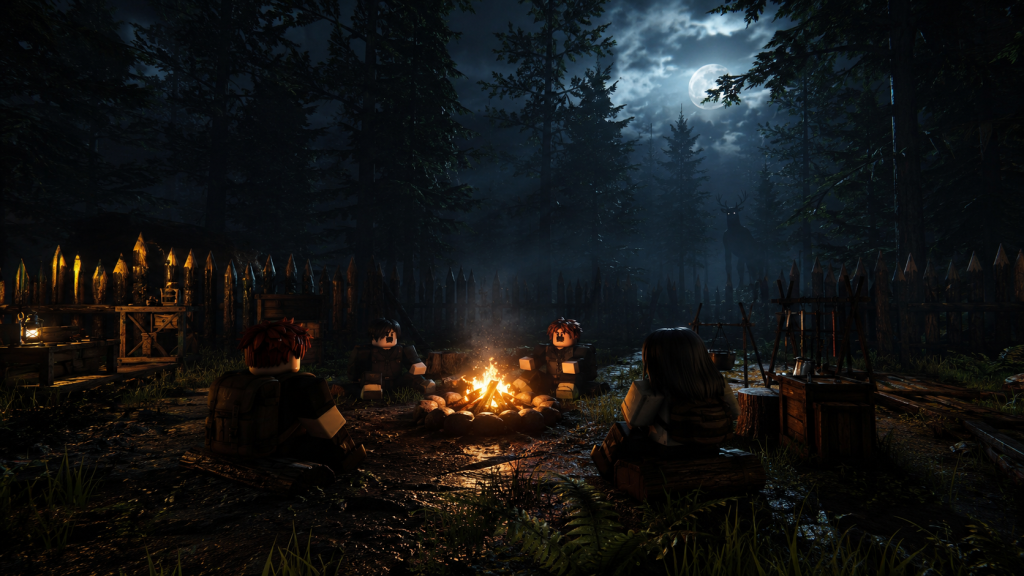
99 Nights in the Forest takes Roblox in a much darker direction.
This is a co-op survival game where you gather resources, build up your camp, craft equipment, and survive increasingly dangerous nights. The game’s official premise hints at something watching from the forest without immediately telling you exactly what it is.
The story starts with reports of a deer standing upright in an unnatural way. Then four children disappear. A police search turns up nothing, the forest is closed to the public, and players are given 99 nights to uncover what happened.
Before entering the forest, there’s a hub with a currency shop, class shop, leaderboards, and daily quests.
You can play solo or create a party.
Once the actual survival run begins, the formula is familiar. Chop down trees, carry the logs back to your campfire, and keep it burning. Resources go into the crafting bench, which lets you turn what you’ve collected into useful equipment.
There’s also a hunger meter to keep track of.
The game follows a day/night cycle beginning on Day 1, and daytime can bring encounters with NPCs such as the Pelt Trader.
Once you understand those basics, things get considerably more involved.
It feels much closer to a proper survival-horror game than the average Roblox experience, with crafting and resource management sitting alongside the horror. If you’ve played The Forest or similar survival games on Steam, the comparison is pretty obvious.
PC Gamer has highlighted the deeper systems behind the premise, including classes, exploration, fire management, crafting, defenses, and resource planning. Players have developed detailed strategies for farming food, selecting weapons, and organizing their camp equipment.
There is one catch: once a group has powerful weapons and a reliable supply of resources, later runs can start feeling repetitive.
6. RIVALS
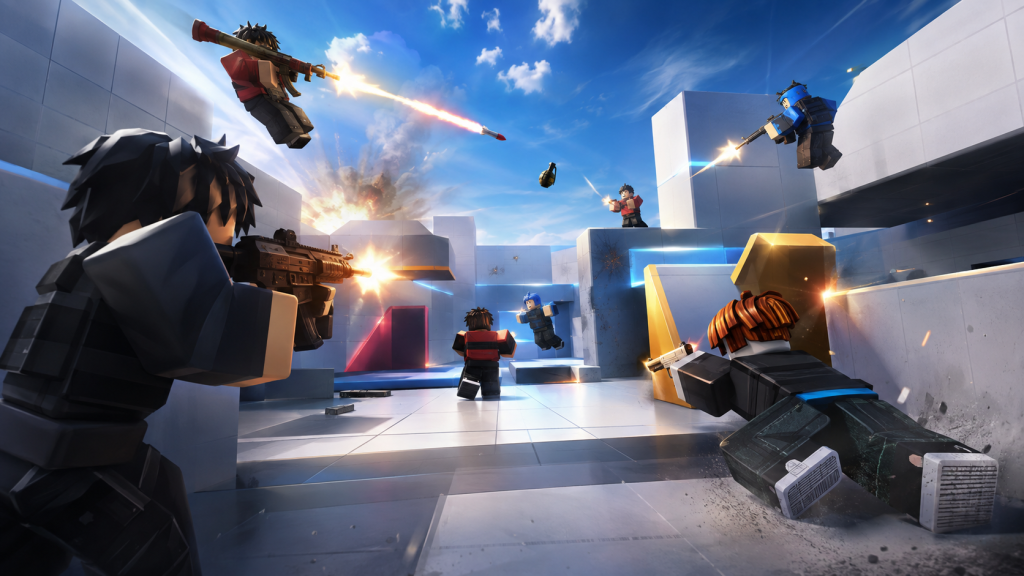
If survival horror isn’t your thing, RIVALS throws you straight into competitive FPS combat.
Matches range from 1v1 to 5v5, and victory goes to the player or team that reaches five round wins first. Between matches, you can earn keys, unlock weapons and skins, complete contracts, and chase win streaks.
Your first experience is a beginner-friendly 2v2 match.
The default loadout gives you an assault rifle, pistol, fists, and a frag grenade, although you can quickly branch out into other weapons. One opponent might show up with a flash grenade and rocket launcher, because apparently that’s how Roblox FPS introductions work.
The arenas themselves are deliberately simple. One early map is basically a collection of geometric shapes without elaborate scenery. It’s pure arena combat.
The hub gives you plenty of other options, including weapon management, leaderboards, rewards, controls, audio settings, and other customization.
At this point, calling RIVALS a simple Roblox shooter undersells it. There’s a genuine skill ceiling here, and movement is almost as important as aim.
PCGamesN has specifically highlighted movement as a major part of the experience, while Games.gg has compared its structured rounds and responsive controls to traditional arena shooters.
The community isn’t quite as united.
Competitive players enjoy learning movement techniques and optimizing their loadouts, while complaints frequently focus on weapon balance, matchmaking, mobile assistance, and toxic behavior.
In other words, RIVALS can be extremely rewarding if you’re trying to get good. It’s just not the game I’d recommend when you’re looking for a relaxing evening.
7. Animal Hospital (Anomaly)
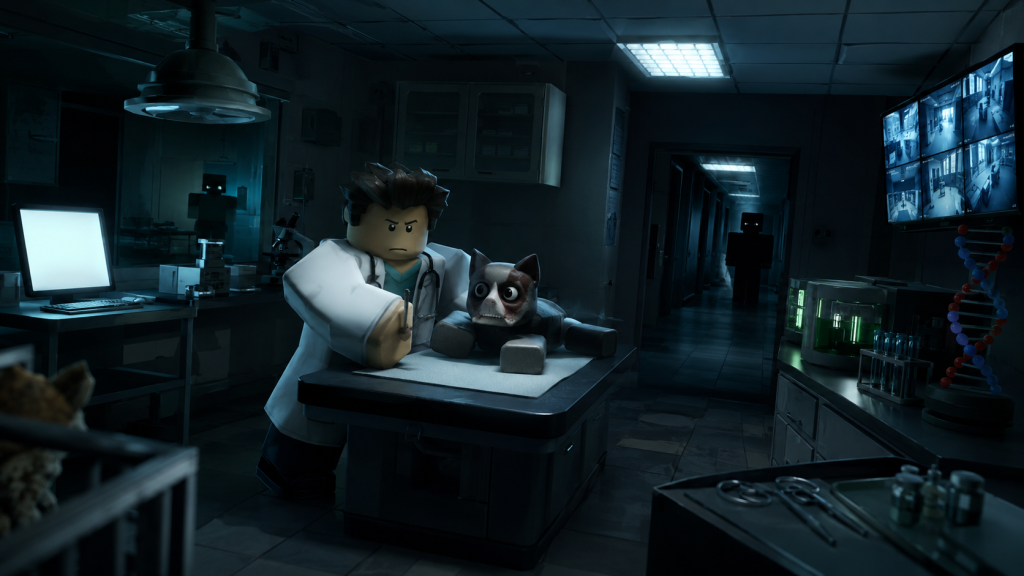
The name Animal Hospital (Anomaly) sounds wholesome.
The night shift says otherwise.
You work at a veterinary hospital where seemingly normal animal patients can actually be creatures disguised as animals. Figuring out which ones are genuine requires observation and investigation, including checking appearances, photographs, CCTV footage, and strange behavior around the building.
It’s part task-management game, part inspection simulator, and part survival horror.
When a patient arrives, your job can involve:
- Stamping the forms.
- Taking a photo.
- Inspecting the photo.
- Registering the patient on the computer.
- Printing a badge.
- Following the patient into a room.
- Taking a DNA sample.
- Analyzing the sample.
- Processing the result.
- Treating the patient according to the instructions above the bed.
If everything checks out, the cured patient leaves the clinic.
Meanwhile, your sanity meter slowly drains. Coffee in the reception office restores it, and that same room contains sticky notes with useful tips.
That’s enough of the explanation. Part of the fun is discovering how the hospital’s strange systems fit together.
The community has also become surprisingly invested in the game’s characters and lore, leading to fan art, theories, and discussions beyond the basic gameplay loop.
Not everyone loves the repetition, though. Some critics find patient treatment tedious, while experienced players say the tension decreases once they’ve learned the anomalies and built up enough supplies.
Still, if you enjoy inspection-focused horror games, this one is worth a look.
8. Jujutsu Shenanigans

Jujutsu Shenanigans is essentially a 3D anime battleground built around Jujutsu Kaisen-inspired combat.
It’s set across an open-world map and lets players throw hands using melee combos, abilities, blocks, dashes, awakenings, parkour, and environmental destruction.
Each character gets four abilities with cooldowns. One example loadout includes:
- Lapse Blue
- Reversal Red
- Rapid Punches
- Twofold Kick
The real fun comes from combining those moves while fighting another player.
There isn’t much hand-holding. Games.gg describes it as a city-wide brawl where players learn by fighting rather than following lengthy tutorials.
That’s part of the appeal.
Fans praise the fluid combat, custom character tools, and destruction physics. Fights can become chaotic very quickly, even when nobody is treating the match particularly seriously.
But the freedom has a downside.
Community discussions frequently mention teamers, experienced players targeting newcomers, uneven matchups, and toxic chat. Public servers can be brutal if you’re still learning the game.
Even so, among Roblox battleground experiences, Jujutsu Shenanigans has considerably more depth than its chaotic presentation might suggest.
9. Fish It!
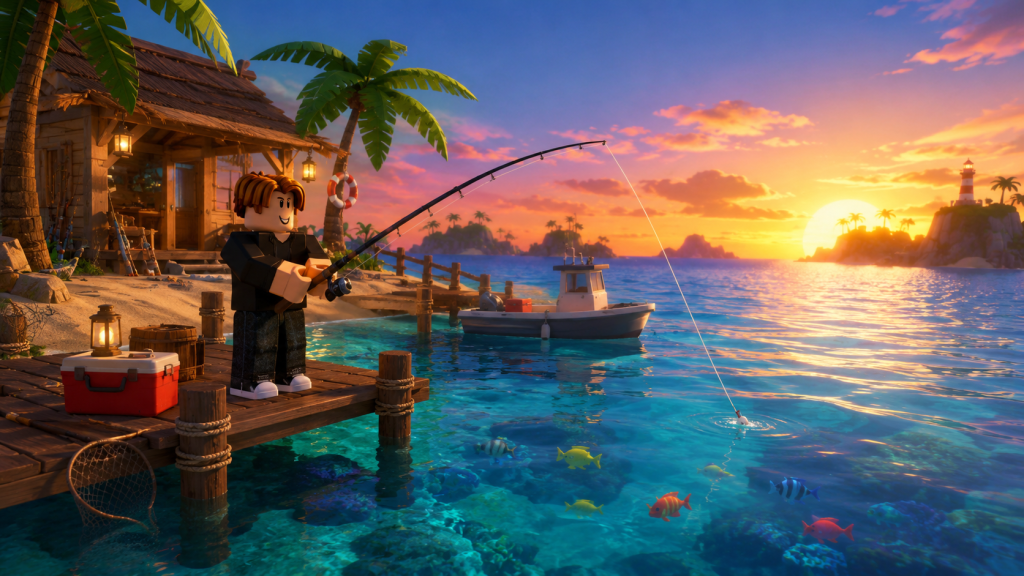
Sometimes you don’t want to fight anyone.
Sometimes you just want to fish.
Fish It! is an incremental fishing simulator built around catching fish, selling them, upgrading your gear, and opening up new areas. You can travel between islands by boat and hunt for extremely rare fish variants.
The game openly lists Fisch and Fishing Simulator as inspirations.
The actual fishing process is interactive rather than completely automated. You play through a fishing minigame, land your catch, then take it to the Fish Merchant to sell.
Your earnings can then go toward:
- New fishing rods
- Gear
- Baits
- Other upgrades
The simplicity is a big reason Fish It! works.
Navigation is straightforward, upgrades come quickly, and the fishing system is forgiving enough that younger and more casual players can understand the progression almost immediately.
That same simplicity is also where the criticism comes from.
Some community members see it as an overly streamlined Fisch imitation, while others question whether its huge player numbers are partly driven by AFK farming.
Still, there’s no mystery about why it attracts people. You catch something, sell it, buy something better, and immediately have another reason to cast the line.
10. Steal a Brainrot
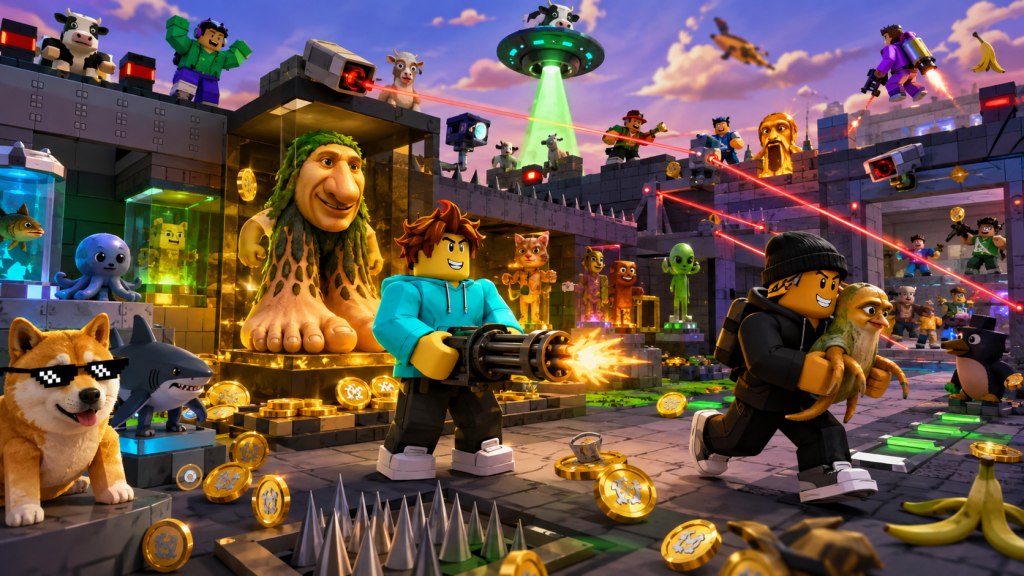
Steal a Brainrot might be the strangest game on this list.
It’s a tycoon-style progression game with a PvP theft system. Instead of growing crops like Grow a Garden, you collect bizarre meme-inspired creatures and place them in your base. Those creatures generate income, but other players can steal them.
So naturally, you have to steal theirs too.
You can also rebirth for additional advantages and purchase equipment designed to interfere with other players.
The tutorial gives you the basic idea immediately:
- Buy Noobini Pizzanini.
- Carry it back to your base.
- Collect the money it generates.
- Protect it from other players.
- Steal other players’ brainrots.
That’s basically the entire pitch.
The absurd creatures and meme-heavy presentation won’t appeal to everyone. I certainly wouldn’t call myself a fan of the setting.
But from a game-design perspective, the loop works surprisingly well.
PC Gamer has described the collecting-and-heist formula as unexpectedly addictive, while Polygon has focused on the harsher side of losing valuable characters, particularly for younger players.
The community is heavily divided. Supporters enjoy the straightforward progression and unpredictable thefts. Critics see a repetitive experience driven by aggressive monetization and short-lived internet memes.
Either way, the player count makes one thing clear: people are having a lot of fun stealing each other’s weird little creatures.
Which Roblox Game Should You Try First?
There isn’t really one “best” Roblox game for everyone. The platform’s biggest strength is how wildly different these experiences can be.
If you want something quick and social, Murder Mystery 2 is an easy starting point. Brookhaven RP is better if you want to hang out and create your own stories. Players who enjoy grinding and character progression should probably start with Blox Fruits, while survival fans have plenty to chew on in 99 Nights in the Forest.
For competitive players, RIVALS and Jujutsu Shenanigans offer very different takes on PvP. Animal Hospital (Anomaly) is the pick for horror fans who prefer investigation over traditional combat, while Fish It! is about as laid-back as Roblox gets.
And then there’s Steal a Brainrot, which asks you to steal meme creatures from strangers and somehow makes that sound like a perfectly reasonable way to spend an evening.
That’s Roblox in 2026, really. The platform has room for all of it.
Leave a Reply